

This piece originally appeared in Geezer magazine. CBF readers can use the code CBF15 for 15% off an annual subscription at Geezermagazine.com through midnight August 15.
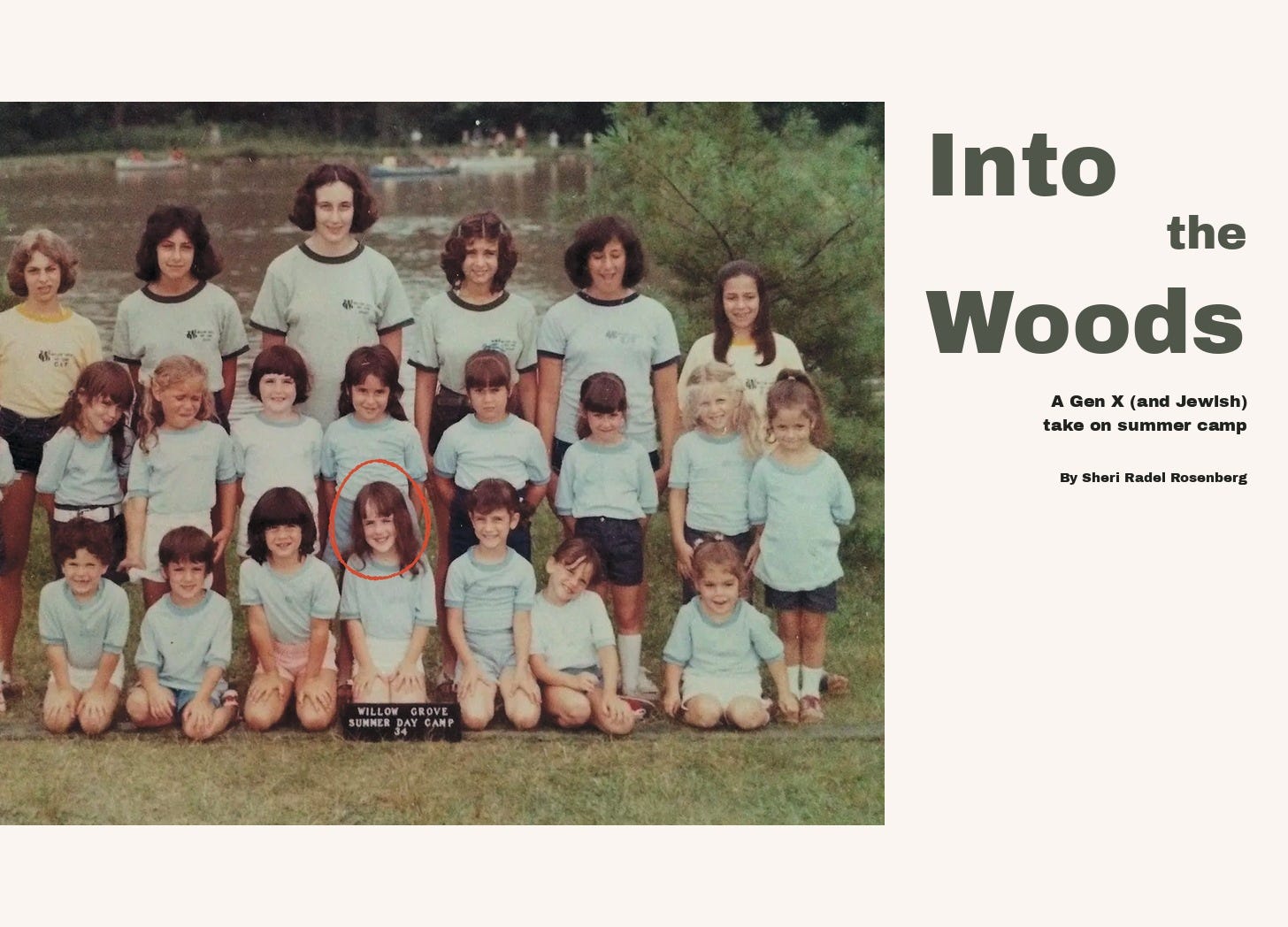
Every summer from the time I was 5 or so, I went to some kind of camp.
This was a rite of passage, loved by generations of Jewish children. But for me, there was something unsettling about lining up for bunks, taking group showers, and doing mandatory activities in the woods. That’s the thing about being Gen X: Our parents wanted us out of the house. The Jewish Community Center had a bus. Off we went.
Summer was not for being home. Summer was for being “somewhere else,” supervised by teenagers barely older than us, learning skills we would never use again, competing in contests we never asked to enter, and collecting emotional wounds that would take decades to unpack.
Willow Grove, or my first op-ed
Willow Grove Day Camp was for rich kids. This was immediately clear—in the quality of other kids’ lunch boxes, in the casual way they talked about vacations and belongings, and in about a thousand tiny signals that children are very good at detecting and pretending not to notice.
My sister loved Willow Grove. She was built for camp: athletic, social, adaptive, outgoing. I was none of these things. I was built for sitting in a corner reading books and being left alone.
Here’s what I liked: the camp newspaper, arts and crafts, and the abandoned fire engine on the playground—rusted, probably tetanus laden, and absolutely the best thing there. You could climb on it and pretend you were somewhere else.
Here’s what I hated: everything else.
The fevered competition. Color war—where you were sorted into teams and made to care deeply about things that did not matter—involved screaming chants, fighting for points, and genuinely weeping when your team lost. The constant measuring. Who had the best Newcomb serve, who could swim the fastest, who was the most spirited, the most enthusiastic, the most camp. I was not spirited. I was not enthusiastic. I was a small, suspicious person with hornet stings and a growing sense that all of this was insane.
I arrived at camp at a normal weight. I came back hollow-cheeked and underfed, having successfully survived three weeks on Twizzlers and spite.
But I did write my first op-ed that summer.
The CITs—counselors-in-training, the 16-year-olds who were one rung above us on the camp hierarchy—had a bench, their bench. It was a place to sit and be cool and watch the rest of us suffer. But then some grown-up in something called Administration decided the CITs shouldn’t have a bench anymore. I don’t remember why. It might have been budget cuts or a half-assed nod to egalitarianism. Or it could have been just the casual cruelty of adults making decisions that affect teenagers without consulting them.
I wrote a passionate defense of the CITs’ right to their bench. I marshaled arguments. I made a case for the 13-year-olds to maintain dominion over their bench. My op-ed was published in the camp newspaper, which was mimeographed and handed out on Fridays. I was certain no one read it except me and possibly my mother.
But guess what. They kept the bench.
I was only 8 years old, but I learned something that summer: If you feel strongly enough about something, you can write about it, and occasionally, it will make a difference.
The overnight that broke me
Then came puberty and with it my parents’ brilliant idea to send me to Jewish Community Center (JCC) overnight camp.
(We didn’t use the term “sleepaway.” I don’t know why. Perhaps “overnight” sounded more temporary, less like we were being sent away and more like we were just staying out late.)
I was a late bloomer. Awkward in the way that only late bloomers can be, still shaped like a child while everyone around me was developing curves and confidence and an understanding of social dynamics I had not yet unlocked. Photos of Keith Richards hung over my bed, not Scott Baio or another Tiger Beat stud. Keith Richards—gaunt, dissolute, and extremely age-inappropriate.
I was a weirdo. I knew I was a weirdo. I leaned into the weirdo.
I liked the counselors. They were older, cooler, willing to talk to me like a person. The other kids weren’t so willing. There’s a particular cruelty to the middle school years, a sorting that happens, a hierarchy that establishes itself with ruthless efficiency.
And then there were the showers.
The communal showers. The group showers. The “we all shower together in one big room” showers. Everyone was at various stages of having or not having the things puberty brings. I cannot overstate how formative this was—and not in a good way. The vulnerability. The exposure. The way your body became a public artifact, something to be assessed and compared.
I went on a hunger strike—not a political hunger strike or a principled stand against injustice. I just stopped eating the food. I couldn’t. The dining hall felt like another arena, another place to be watched and judged. So I ate only the candy my parents sent in care packages—contraband sugar, smuggled into the cabin, consumed in secret as if I were a raccoon.
I arrived at camp at a normal weight. I came back hollow-cheeked and underfed, having successfully survived three weeks on Twizzlers and spite.
Here are some other memories from that summer.
A prisoner escaped from the nearby correctional facility. The counselors patrolled the perimeter of the camp, protecting us from … what exactly? An escaped convict wandering through the Pennsylvania woods looking for a cabin full of Jewish middle schoolers? It seems absurd now. It seemed absurd then. But there they were, flashlights in hand, shielding us from danger while we lay in our bunks pretending to sleep and wondering if we were going to die.
Food poisoning swept through the camp. Everyone got sick. Everyone except me, that is, probably because I wasn’t eating the food. While the other campers were bused to local hospitals, I sat alone in the gymnasium and watched Moonraker. Roger Moore slid across a screen the size of a wall. I ate a Snickers bar. It was, in retrospect, Gen X iconic. The apocalypse happens, and you just watch a movie. You survive. You keep going.
There was a boy that summer. A weird boy, weird like me, an outsider like me, someone who didn’t fit the camp mold. We held hands. That was it. That was everything. We held hands and talked about music and didn’t quite belong, and it was the first time I understood that there were other people like me out there, that being a weirdo didn’t mean being alone.
He’s in some art band in New York now. I see his name sometimes. I think about that summer—the showers, the hunger strike, the escaped prisoner, Roger Moore’s eyebrows—and I think about holding hands with someone who understood.
9th Grade B (Panama)
And then salvation arrived in the form of teen tours.
If overnight camp was purgatory, teen tours were heaven. Our bunk was called 9th Grade B. We sang it to the tune of Panama by Van Halen. NINTH GRADE B! DUN DUN, DUN DUN. NINTH GRADE B-EE-EE-EE-EE-EE!
Reader, there were boys. Not the boys from home, whom I’d known since kindergarten and who therefore didn’t count. Exotic boys. Boys from New Jersey. Jewish boys with new wave haircuts. Boys who had opinions about music. Boys who dressed like they were in a Duran Duran video. Preppy boys!
I developed a crush on a boy in an Echo & the Bunnymen cover band.
Of course I would fall for the guy doing Ian McCulloch covers at a JCC in central New Jersey. This was destiny. This was fate. This was exactly the person I was always going to be.
We went everywhere that summer. New Orleans. California. Some kind of dude ranch. I have vague memories of horses, of cowboy hats worn ironically, of feeling impossibly free. We were supervised, technically, but the leash was long and we were full of feelings and convinced that everything mattered enormously.
It was truly the tits.
The freedom, the friends, the sense that the world was big and available and waiting for us. The JCC pool and the bus rides and the inside jokes that felt like language, like belonging. 9th Grade B. Panama. The Echo & the Bunnymen boy, whose name I’ve forgotten but whose haircut I remember perfectly.
What they were really teaching us
Here’s what I think about now, looking back:
They sent us away—our parents, I mean. Every summer, for years, they put us on buses and sent us into the woods to be supervised by teenagers. There was no way to reach us—no cell phones or email, just letters that took days to arrive. They didn’t know what we were eating (candy), or how we were sleeping (badly), or what was happening to us emotionally (a lot). They just trusted that we would come back in August, slightly feral, deeply tanned, and somehow better for the experience.
And maybe we were. Maybe there was something valuable in the benign neglect of it all. The independence. The problem-solving. The discovery that you could survive a hunger strike, an escaped prisoner, a communal shower, a color war you didn’t believe in.
Or maybe we were all just mildly traumatized in ways we’re still unpacking. It’s hard to say.
But I think about that CIT bench sometimes and my first op-ed. My first experience of writing something that mattered, that changed an outcome, that proved words could do things in the world. I think about how I’d climb on the abandoned fire engine and look out at the other kids playing games I didn’t understand—apart, observant, already taking notes.
I think about the weird boy who held my hand.
I think about the feeling of being 15 and free and part of something.
Maybe that’s what camp taught me: how to watch, how to survive, how to find the other weirdos and hold their hands.
This was such a fun read! Growing up in New Zealand, summer camp always seemed like such an otherworldly experience (like so many American things we only saw on TV). When I was 18, I ended up going to Maine and working as a counsellor, so I got to see it up close, but still did not quite know it in the way of the campers. It was so interesting to read your experience, how it changed over the years and what that ultimately gave you. Thanks for sharing
so good.